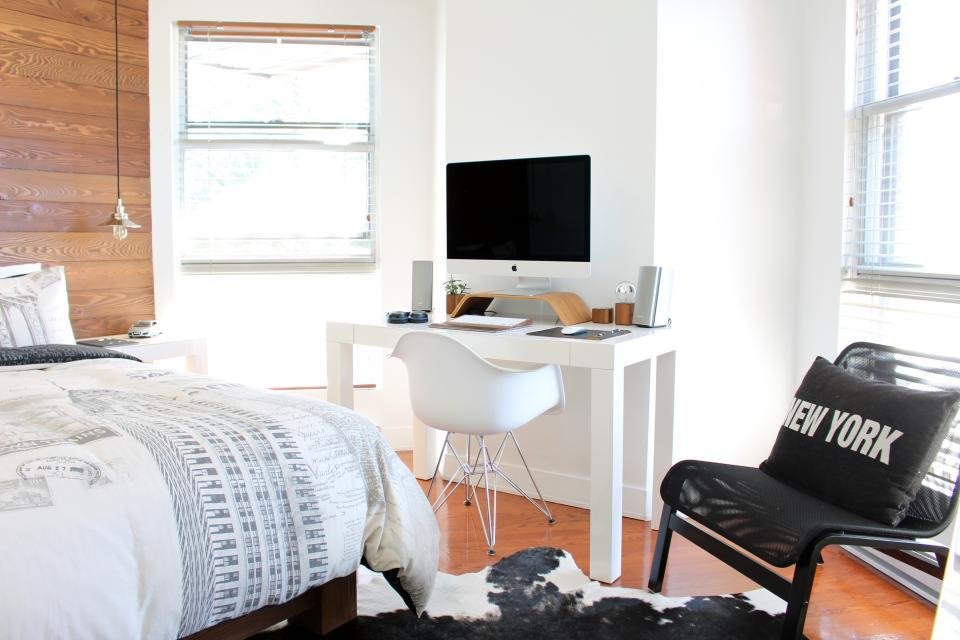
Most home offices are assembled, not designed. A desk arrives, a chair follows, and a year later you're working in a corner that fights you every afternoon. Designing the room instead only takes a little sequencing — and it starts nowhere near the furniture showroom.
1. Start with the light, not the furniture
Before you measure for a desk, watch the room for a day. Note where the sun lands in the morning and where it's gone by four. The single best position for a desk is usually side-on to a window: you get soft, even daylight across the surface without a screen-killing glare behind you, and without staring into the light yourself.
Facing a window is romantic and briefly blinding. Backing onto one turns your monitor into a mirror and your face into a silhouette on every video call. Side-on is the quiet winner almost every time.
2. Choose desk depth before anything else
Width is flexible; depth is not. A desk shallower than about 60 cm (24 in) forces your monitor too close to your eyes and leaves nowhere to rest your forearms. Aim for 70–80 cm deep if you use an external monitor. Everything else — width, material, drawers — you can compromise on. Depth you cannot.
Your monitor should sit roughly an arm's length away. If you can't stretch out and nearly touch it, your desk is too shallow — no chair adjustment will fix that.
3. Buy one good chair
If you spend money anywhere, spend it here. A chair is the one object touching you for eight hours; a bad one is a slow tax on your back and your mood. That doesn't mean a giant gaming throne — a well-made task chair or even a considered mid-century shell chair with the right height works. It means adjustable seat height, support at the lower back, and a seat edge that doesn't dig into your legs.
The Eames studio understood this in 1956: a chair should be a warm, well-worn baseball glove, not a piece of gym equipment. Buy the best chair you can once, and keep it for a decade.
The details are not the details. They make the design.
Charles Eames meant it literally. A workspace lives or dies on the small decisions — where the light falls, how the cables run, whether the chair fits — far more than on the hero piece of furniture.
4. Zone the mess out of sight
A calm desk is mostly a storage problem solved once. Give every category of clutter a home below the work surface or behind you: a drawer for cables and chargers, a tray for the six things you reach for daily, a shelf for everything else. The rule is simple — if you don't touch it most days, it doesn't earn a place on the surface.
In a shared room, a single closed cabinet does more for the look of a workspace than any amount of styling. When work ends, the mess disappears behind a door and the room becomes a living room again.
5. Keep colour and materials calm
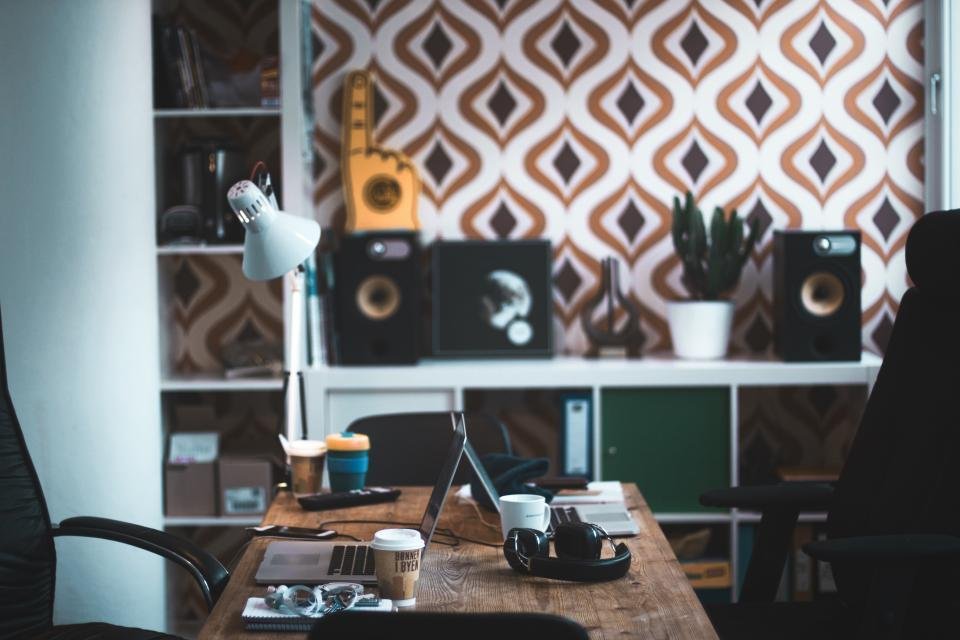
A workspace you look at all day should sit quietly. Choose one warm neutral for the large surfaces — a soft plaster, oat or greige — and let a single accent do the talking through a chair, a lamp or a print. Natural materials age gracefully: oak, walnut, wool felt and cork all look better after a year of use, where plastic and painted MDF only look worse.
If you want energy, borrow the Bauhaus trick: keep the room neutral, then place one bold geometric object — a red lamp, a yellow tray, a blue chair — as the exception. Contrast reads as intentional; a rainbow reads as noise.
6. Solve cables once
Nothing dates a workspace faster than a nest of cables. Fix it structurally, not with a drawer full of clips: run a power strip along the back of the desk, route everything down one leg, and charge phones and headphones out of sight. A clean surface is almost always a hidden-cable problem you dealt with a single time.
7. End with one personal object
A perfectly minimal desk can feel like a hotel room. Once the function is right, add exactly one thing that's only there for you — a ceramic, a photograph, a plant that's outlived three laptops. It's the difference between a workspace and your workspace, and it costs nothing but restraint.
Design the room in that order — light, depth, chair, storage, colour, cables, one object — and you end up with something rare: a home office you're glad to sit down at, and just as glad to walk away from at six.