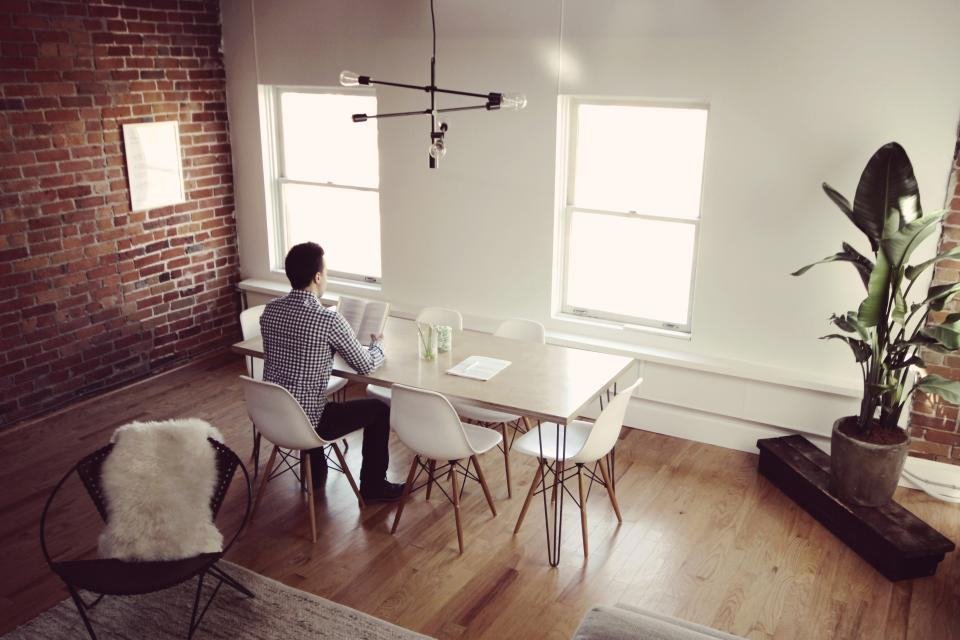
Almost every desk sold is between 73 and 76 cm high. That figure isn't the result of careful research into modern bodies — it's an inherited industry convention, sized around an average adult male. If you're shorter than about 180 cm, a standard desk is probably too tall for you, and you've been quietly compensating for it with raised shoulders or bent wrists ever since.
Why "standard" desk height fits nobody
The problem with a single standard is that the relevant measurement isn't your height — it's your seated elbow height, which varies between people of the same overall height depending on torso and leg proportions. Two people who are both 175 cm tall can comfortably need desks several centimetres apart.
What a too-tall desk does to you is predictable: your shoulders creep up to reach the keyboard, your wrists bend upward, and by mid-afternoon your neck and upper back are carrying the tension. A too-low desk is rarer, and rounds your back forward instead.
Measure your own elbow height
Thirty seconds, no tools beyond a tape measure:
- Sit in your chair with your feet flat on the floor and your back against the backrest. Set the chair height first, so your knees sit at roughly 90 degrees.
- Let your upper arms hang straight down, relaxed against your sides.
- Bend your elbows to 90 degrees so your forearms are parallel to the floor.
- Measure from the floor to the underside of your elbow. That's your seated elbow height.
Your desk surface should sit at — or within a centimetre or two below — that number. That's it. Everything else in an ergonomic setup is built on top of this one measurement.
If your keyboard sits on a tray or a riser, measure to the keyboard, not the desktop. The height your hands actually work at is the one that matters.
Desk height by your height
If you can't measure right now, these are reasonable starting points for a seated desk. Treat them as a first guess to refine, not gospel — proportions vary a lot.
- 150 cm — roughly 60 cm desk height
- 160 cm — roughly 65 cm
- 170 cm — roughly 70 cm
- 175 cm — roughly 72 cm
- 180 cm — roughly 74 cm
- 185 cm — roughly 76 cm
- 190 cm — roughly 78 cm
- 195 cm — roughly 80 cm
Notice that a standard 74 cm desk only really suits people around 180 cm. If you're 165 cm, that desk is about 7 cm too tall — which is why it feels like you're reaching up to type, because you are.
How to fix a desk that's the wrong height
Most desks aren't adjustable, so you adapt around them. In order of preference:
- Desk too tall (the common case): raise your chair until your elbows meet the desk, then add a footrest so your feet are still supported. A box, a ream of paper or a stack of books works exactly as well as a bought one. This is the single most effective fix, and it costs nothing.
- Desk too tall, chair already at maximum: add a keyboard tray below the desktop, or put the keyboard on a lower side surface.
- Desk too low: raise it on furniture risers, sturdy blocks, or bed-raiser cups under each leg — then check it's still stable before you trust a laptop to it.
- Buying new? Look for adjustable legs, or buy the top and legs separately so you can choose the height. That usually costs no more than a fixed desk.
Once the desk height is right, set the screen — the second half of the geometry is in our guide to monitor height and distance.
Standing desk height
The same principle applies standing: measure your standing elbow height with arms relaxed and elbows at 90 degrees, and set the desk there. For most adults that lands somewhere around 95–120 cm, which is why sit-stand desks need such a wide travel range.
Two things people get wrong when standing: setting the desk slightly too low, so they lean over it; and forgetting that the monitor also needs to rise, since your eye level has gone up by 30 cm or more. If you're weighing one up, we've written an honest verdict on whether standing desks are worth it.
The dining-table problem
Dining tables run 74–76 cm — at the tall end of desk heights — and dining chairs have no height adjustment, no lumbar support and a flat seat. It's the worst common combination, and it's what a great many people worked at for years.
If the dining table is your desk, you can still make it workable: raise the chair with a firm cushion until your elbows reach the table, add a footrest so your feet aren't dangling, and put something behind your lower back for support. Add a laptop stand and external keyboard and you've solved most of the rest for very little money.
One measurement, taken once, fixes a problem most people carry for years. Sit down, drop your arms, bend your elbows, and measure — then make the desk meet you, rather than the other way round.
Frequently asked questions
What is the standard desk height?
Most mass-produced desks are around 73 to 76 cm (about 29 to 30 inches) high. That standard was set around an average adult male and is too tall for many people, which is why so many desks feel slightly wrong. Your own seated elbow height is the number that matters.
How do I know if my desk is the right height?
Sit with your feet flat and your back supported, then let your arms hang and bend your elbows to 90 degrees. Your forearms should be level with the desk surface. If your shoulders lift to reach the desk it's too high; if your wrists angle downward it's too low.
What desk height do I need for my height?
As a rough guide, someone around 160 cm tall suits a seated desk of about 65 cm, 170 cm suits about 70 cm, 180 cm suits about 74 cm, and 190 cm suits about 78 cm. These are starting points only, so measure your seated elbow height and use that.
Can I work at a dining table?
For short periods, yes. Dining tables are usually 74 to 76 cm high, which is too tall for most people to type at comfortably, and dining chairs offer no lumbar support or height adjustment. Raise the chair with a cushion and add a footrest if you use one regularly.