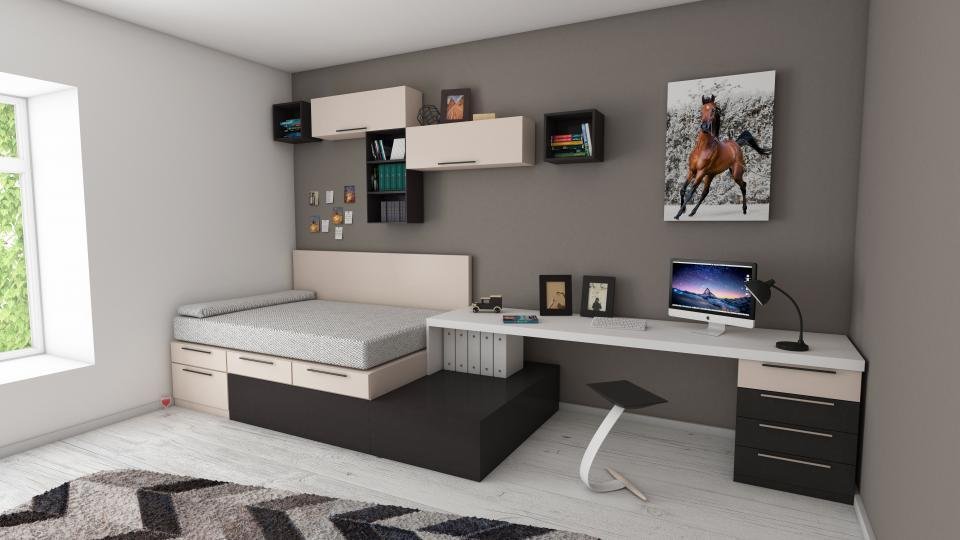
A bedroom office is the most common home-office setup there is, and the trickiest to get right — because you're asking one room to do two opposite jobs. One wants you alert; the other wants you asleep. Do it thoughtlessly and you get a room that's bad at both. Do it well and no one would guess you work there.
The real problem: two rooms in one
The issue isn't space, it's psychology. When your laptop is the last thing you see before sleep and the first thing you see on waking, your brain never fully clocks off. Sleep researchers are consistent on this: the bedroom works best when it's associated with rest. So every decision below has one goal — let you work well by day, then make the work disappear at night.
Where to put the desk
Two rules do most of the work:
- Put the desk on a different wall from the bed, ideally where you can't see the bed while working (and can't see the desk from the pillow). Facing a wall or window beats facing the bed — a made bed is a nap invitation, an unmade one is a guilt trip.
- Go side-on to the window for soft daylight without glare, exactly as in our lighting guide.
If the room only allows the desk near the bed, angle it away and lean on the dividing tricks below.
In a tight room, a slim desk can double as an oversized nightstand on the far side of the bed — one piece of furniture doing two jobs, which is the whole small-space game.
Divide the space without a wall
You don't need to build anything to create two zones. Any of these draws a line the eye respects:
- A bookshelf placed perpendicular to the wall — storage and a room divider in one.
- A curtain or folding screen you can pull across the work zone at night.
- A rug under the desk that visually "claims" the work area as its own territory.
- A colour or a plant wall that marks the desk corner as distinct from the sleep corner.
Hide the work at night
This is the single most important habit. At the end of the day, the work should go away — physically, not just mentally:
- Close the laptop and stow it in a drawer or on a shelf. Out of sight genuinely helps you switch off.
- Use closed storage so paperwork and cables aren't the last thing you see. A cabinet or a box beats open shelving here.
- Switch off the desk lamp as a deliberate "day's done" ritual — a small cue your brain learns fast.
Route the cables once (see our cable-management guide) so the desk can go from workstation to quiet corner in ten seconds, not ten minutes.
Layouts for a small bedroom
- The alcove desk. A shallow desk tucked into an alcove or beside a wardrobe keeps it out of the main sightline and out of the walkway.
- The floating wall desk. A wall-mounted top with no legs frees the floor and reads light in a room that's already full.
- The foot-of-the-bed console. A narrow console behind or beside the bed becomes a standing-height perch for short work sessions.
- The closet office. If you have a spare wardrobe, a desk built inside it closes behind doors at night — the cleanest separation of all.
Get the placement and the nightly disappearing act right, and a bedroom office stops being a compromise. You work well in the daylight, then close the laptop, kill the lamp, and the room quietly goes back to being somewhere you sleep.
Frequently asked questions
Is it bad to have a desk in your bedroom?
It isn't harmful, but work and sleep compete for the same room, which can make it harder to switch off. The fix is separation: position the desk out of sight of the bed if you can, and hide or cover the work at the end of the day so the room reads as a bedroom again.
Where should a desk go in a bedroom?
Ideally against a different wall from the bed and side-on to the window for good daylight, so you're not staring at the bed while you work or into glare. In a small room, a corner or an alcove keeps the desk out of the main sightline from the pillow.
How do you separate a home office in a bedroom?
Use a visual divider: a bookshelf, a curtain, a folding screen, or even a rug that zones the work area. Closed storage that hides the work at night, and a lamp you switch off to signal the end of the day, do the psychological separation a wall would.