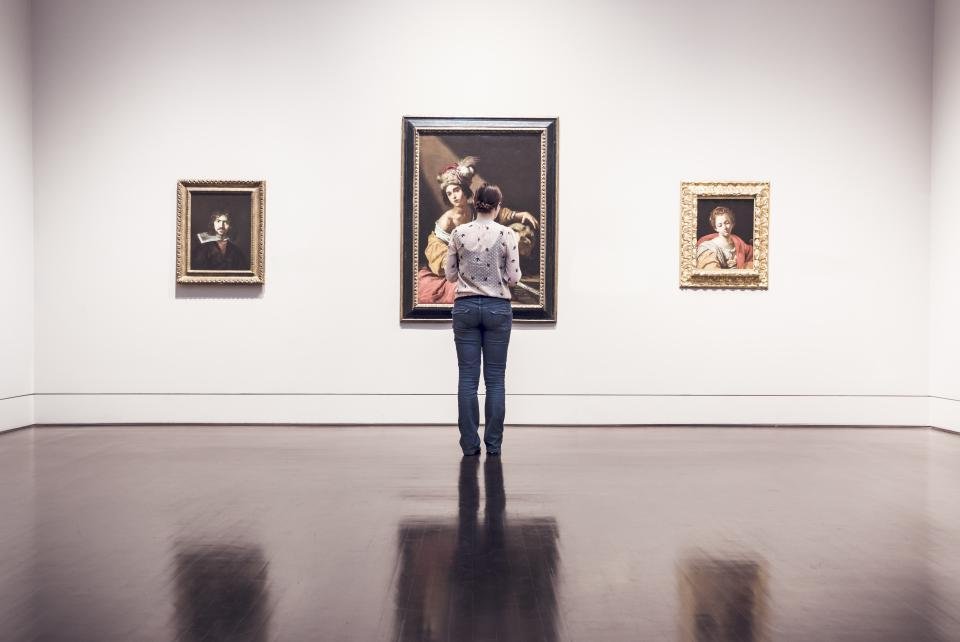
Most home-office walls are either bare or a jumble of whatever was lying around. Both are missed opportunities, because you have two very different walls to think about — and they want opposite things.
Two walls, two jobs
- The wall you face (behind your monitor) should be calm. Anything busy here competes with your screen and pulls your focus all day. A quiet colour, one restrained piece, or nothing at all.
- The wall behind you is your backdrop on every video call — this is where the personality goes. It's the one people actually see of your space.
Get those two roles the right way round and half the work is done.
Ideas beyond a single print
- One oversized piece. A single large artwork reads as confident and needs no arranging.
- A gallery wall. A cluster of smaller frames — the most flexible option (more below).
- Floating shelves. Lean art, prop books and a plant; restyle whenever you like without new nail holes.
- A pin or peg board. Practical and personal — good above a desk if kept tidy.
- A mirror. Bounces daylight into the room and makes a small office feel bigger.
- Something three-dimensional — a woven hanging, a clock, a single sculptural object — adds texture a flat print can't.
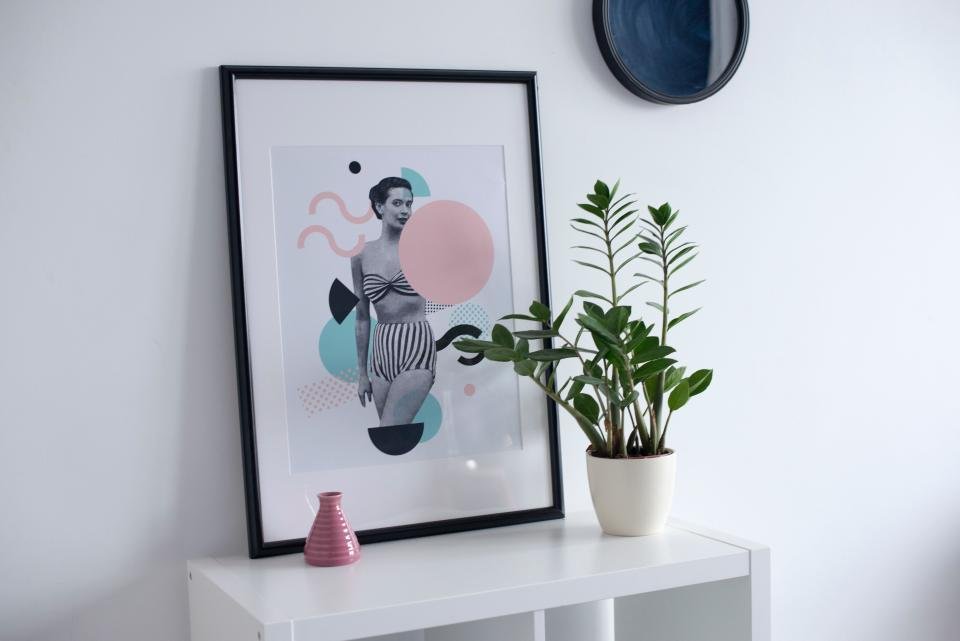
How to build a gallery wall
- Lay it out on the floor first. Arrange the frames until the whole group feels balanced before a single nail goes in.
- Keep even gaps — about 5–8 cm between frames — so it reads as one composition, not scattered pieces.
- Unify the mix. Wildly different artworks look intentional when the frames (or the mounts) match.
- Anchor it. Treat the whole arrangement as one big rectangle and centre that at eye level.
- Trace and tape. Cut paper templates, tape them up, and live with the layout for a day before committing.
Even a lively gallery wall works if you hold the palette to two or three colours that echo something already in the room. Contrast reads as design; a rainbow reads as noise.
Get the height right
The most common error is hanging art too high. Aim for the centre of the piece at eye level — roughly 145–150 cm from the floor. Above a desk, leave about 20–30 cm between the desktop and the bottom of the frame so the art relates to the furniture instead of floating off on its own.
Common mistakes
- Too high, too small. A lone postcard-sized frame marooned high on a big wall. Go bigger or group up.
- A busy wall facing you. Save the energy for the wall behind you; keep your eyeline calm.
- Ignoring the video frame. Check what the camera actually sees — see our video-call guide — and style that slice.
- All flat, all matte. One textured or three-dimensional element stops a wall feeling like a catalogue page.
Calm wall in front, characterful wall behind, everything hung at eye level: that's a home office that looks composed from your chair and from everyone else's screen.
Frequently asked questions
What should I put on the wall behind my desk?
Keep the wall directly behind your monitor calm so it doesn't distract you while you work, and save the statement piece for the wall behind you, which is what shows on video calls. A single large artwork, a small gallery wall, or floating shelves all work.
How do I arrange a gallery wall?
Lay the frames out on the floor first and shuffle until it looks balanced, keeping consistent gaps of about 5 to 8 cm. Hang the centre of the whole arrangement at eye level, and unify mismatched art with matching frames or mounts.
How high should I hang art in a home office?
Hang so the centre of the piece sits around eye level — roughly 145 to 150 cm from the floor. Above a desk, leave about 20 to 30 cm between the top of the desk and the bottom of the frame so it relates to the furniture.